
The LinkedIn Algorithm is not in chaos. It has matured.
From news feed to recommendation system

TL;DR
LinkedIn hasn’t entered chaos, nor has its algorithm turned against creators. What many interpret as disruption is a natural evolution of a recommendation system that now prioritizes context, relevance, and professional value over noise and short-term tactics.
This evolution rewards consistency, clarity, and genuine contribution, and reinforces LinkedIn as an expertise-first, business-first platform, not an entertainment feed.
Why so many people feel like “nothing works anymore”
Every serious platform reaches a phase where growth forces refinement.
Not a dramatic reset.
Not a collapse.
But a maturation phase.
When this happens, surface tactics stop working before the deeper logic becomes visible. On LinkedIn, this shows up as falling reach, fewer viral spikes, and constant speculation about “what the algorithm even wants?”
The real change is structural.
LinkedIn is no longer trying to show more content.
It’s trying to show better-matched content to its users.
LinkedIn has quietly moved from behaving like a chronological feed toward operating as a recommendation system. One designed to connect people with ideas that are relevant to them, not merely recent or popular.
From posts to context: how decisions are made now
Content on LinkedIn is no longer evaluated in isolation.
A post is interpreted as part of a broader professional signal that includes:
who publishes it,
what they usually talk about,
who engages with them,
how the content performs over time,
and whether people actually use it.
This explains why:
posts can resurface weeks later,
frequency alone no longer guarantees reach,
similar content performs differently depending on the author.
This isn’t randomness.
It’s contextual relevance.
About “360Brew”: a useful label, not a magic switch
The term 360Brew AI model exists because people needed language for a shift they could feel.
It does not describe a single new algorithm replacing old ones.
It points to a more integrated decision model where multiple signals are evaluated together rather than sequentially.
In practice, this means:
posts aren’t judged purely on early engagement,
user behavior compounds over time,
relevance outweighs momentary performance.
The name itself isn’t important.
The direction is.
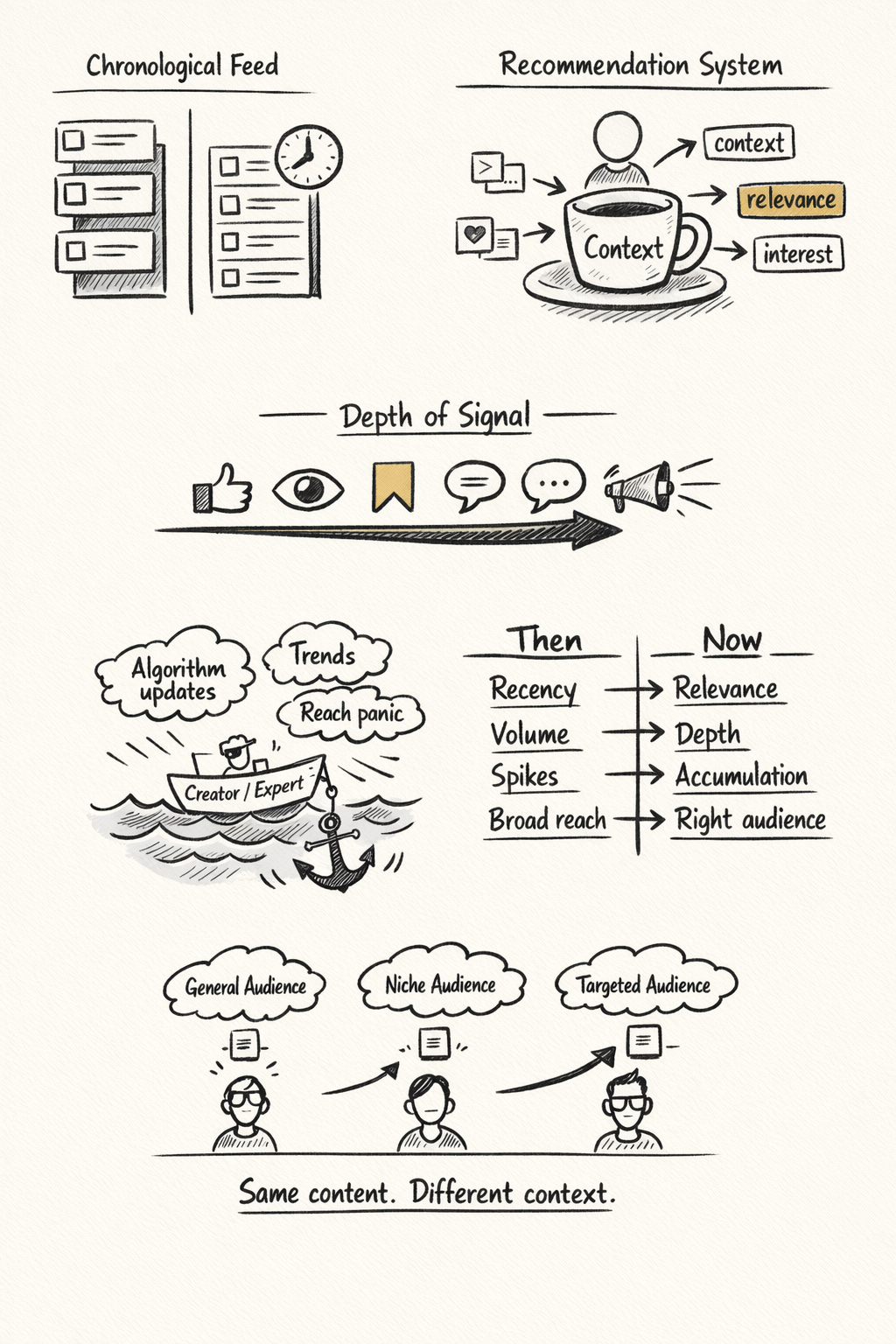
Engagement didn’t disappear. It became layered.
Engagement was not removed.
It was re-interpreted.
LinkedIn now reads engagement across depth:
quick reactions (likes),
attention (time spent),
intent (saves, profile clicks),
contribution (substantive comments),
amplification with meaning (shares with added insight).
This favours content people return to, not content designed only to trigger reflex reactions.
💡 I am noticing something that doesn’t surprise me at all. Those who continued to deliver valuable content week to week, and whose overall “vibe” feels genuinely helpful, have regained a substantial portion of their former impression levels. While impressions initially fell anywhere between 50% and 80% on average, these users are now back to roughly 30–50% below their previous levels at most (at least among my clients).
Why LinkedIn is optimizing for long-term trust
Every platform must eventually choose between stimulation and trust.
LinkedIn’s direction is clear.
In professional environments, trust compounds through:
consistency,
clarity,
repeated exposure to useful thinking,
alignment between expertise and expression.
A system optimized for trust naturally:
rewards depth over novelty,
favors relevance over spectacle,
reduces the impact of noise without suppressing creativity.
Creativity still belongs here, but creativity in service of understanding.
Consistency as a stabilizing force
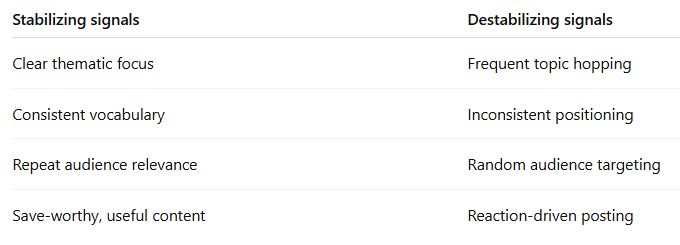
In a relevance-driven system, consistency acts like an anchor.
When themes, language, and positioning remain aligned over time, the system gains confidence in:
who your content is for,
when it should be shown,
and why it matters.
Inconsistency introduces ambiguity.
Ambiguity reduces distribution confidence.
Consistency does not mean repetition.
It means coherence.
This is especially powerful for experts, consultants, and business-focused creators who build authority over time rather than chasing spikes.
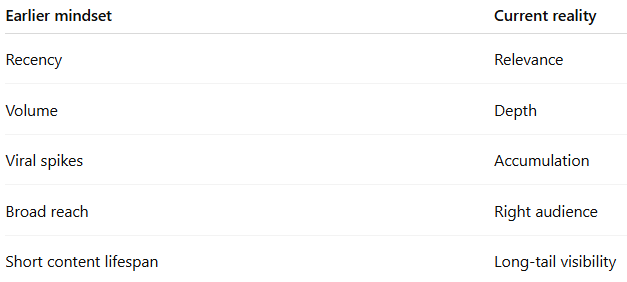
Old mental model vs. current reality
How LinkedIn thinking evolved
A LinkedIn profile now functions as an interpretation layer.
It provides signals about:
thematic focus,
professional credibility,
audience alignment.
Profiles with clarity make distribution easier.
Profiles without focus introduce hesitation.
This is not punishment. Rather, a pattern recognition.
What signals actually matter now (and why)
Not all engagement is created equal anymore.
As LinkedIn has shifted toward a recommendation-driven model, the platform has become far more selective about what kind of interaction it treats as a signal of quality. The system is no longer asking whether people reacted. it’s asking how they interacted, and with what level of intent.
Some recent large-scale analyses of millions of posts point to a clear pattern: signals that indicate lasting value now outweigh signals that indicate momentary reaction.
That distinction matters.
A like is fast.
A save is deliberate.
A thoughtful comment requires effort.
The algorithm increasingly mirrors that hierarchy.
Why saves carry disproportionate weight
A save is one of the clearest expressions of intent a reader can make.
It means:
“This helped me.”
“I want to return to this.”
“This is not just interesting, it’s useful.”
From a system perspective, that’s a powerful indicator of durable value. Content that gets saved is more likely to be relevant beyond the moment it was published, which aligns perfectly with LinkedIn’s move toward longer content lifecycles.
In other words, saves signal future usefulness, not just present appeal.
Depth beats speed in comments
Comments still matter, but not all comments equally.
Quick reactions or short affirmations register as lightweight interaction. In contrast, comments that:
add a new perspective,
ask a substantive question,
or extend the original idea
signal that the content triggered real thinking.
These responses take time.
Time implies cognitive engagement.
That’s why in-depth comments increasingly outperform sheer volume of reactions. They tell the system that the post didn’t just interrupt someone’s scroll - it held their attention.
Comment threads indicate discussion, not broadcast
One of the most underappreciated signals today is conversation between readers.
When people reply to each other in the comments, rather than only to the author, it changes the nature of the content. The post stops being a one-way broadcast and becomes a shared discussion space.
From the algorithm’s point of view, that’s extremely valuable:
it suggests relevance across multiple viewpoints,
it extends time-on-post,
and it creates secondary engagement loops.
Discussion scales relevance far better than monologue.
Reposts as endorsement, not amplification
Reposts still matter, but for a different reason than before.
A repost isn’t just distribution. It’s endorsement.
Someone is effectively saying:
“This reflects well on me if I share it.”
That reputational cost makes reposts a stronger signal than casual reactions. They indicate alignment, not just agreement—and that alignment helps the system understand where the content belongs.
Attention is measured in time, not clicks
Dwell time has quietly become one of the most reliable indicators of quality.
Did people actually read the post?
Or did they scroll past after two seconds?
The platform can detect that difference.
Content that holds attention—even without immediate interaction—often performs better over time than content that sparks quick reactions but fails to sustain interest. This reinforces the idea that reading is a form of engagement, even when it’s silent.
Why delayed engagement is a positive signal
Another important shift: engagement that arrives later is no longer a weakness—it’s often a strength.
Posts that continue to receive saves, thoughtful comments, or shares 24–72 hours after publishing signal something critical: enduring relevance.
Instead of peaking fast and fading, these posts demonstrate staying power. That makes them strong candidates for recommendation surfaces, where the goal is not novelty, but usefulness.
Longevity now competes with immediacy—and often wins.
What matters less than most people think
As these deeper signals gain importance, some traditional metrics naturally lose influence.
Raw like counts without follow-up interaction contribute less than before.
Posting frequency alone no longer guarantees visibility.
Early engagement spikes matter less if they don’t translate into sustained interest.
Even follower count, while still relevant, no longer acts as a reliable proxy for impact. Large, passive audiences generate weaker signals than smaller, engaged ones.
The system is no longer not optimizing for noise. It’s now optimizing for meaning.
Why comparing reach isn’t relevant anymore
Reach is no longer universal.
LinkedIn optimizes for:
repeated relevance,
smaller but aligned audiences,
cumulative exposure.
This lowers headline numbers but increases signal quality.
For business-driven creators, this is a net positive.
Huge followings matter less in 2026.
Strong communities matter more.
For years, follower count was treated as a proxy for influence.
More followers meant more reach.
More reach meant more authority.
More authority meant more business opportunities.
That logic is steadily losing relevance.
In a recommendation-driven environment, distribution is no longer guaranteed by audience size alone. It is shaped by relevance, repeated interaction, and the strength of relationships between people and ideas.
What increasingly matters is not how many people follow you, but:
how many regularly engage with your thinking,
how many return to your content,
how many associate your name with a specific topic or point of view.
Large audiences are inherently broad.
Broad audiences dilute context.
Strong communities, on the other hand, do the opposite. They concentrate relevance.
A smaller group of people who consistently:
read,
save,
respond,
and build on your ideas,
sends far stronger signals than a passive following ten times the size.
This is why many creators with modest follower counts now experience:
more stable visibility,
more meaningful conversations,
higher-quality inbound opportunities
than those with large but loosely connected audiences.
Communities create continuity.
Continuity creates trust.
Trust compounds.
This is especially important in professional environments, where influence is not measured by applause, but by credibility.
In that sense, LinkedIn’s evolution quietly favors those who build relational depth over numerical scale. It rewards people who show up consistently for a clearly defined group and contribute to its thinking over time.
Now look, I’m not saying that large followings are suddenly a bad thing. Not at all.
Follower count still has a role.
But it is no longer the foundation.
The foundation is community.
And communities are built not through performance, but through presence.
Signals that stabilize vs. destabilize reach
Welcoming the shift: quality, expertise, business first
These changes are worth welcoming.
They protect LinkedIn from becoming another entertainment-first feed driven by short attention cycles. They preserve its role as a platform where:
expertise compounds,
professionalism matters,
business conversations retain depth.
Creativity still has a place, but creativity in service of clarity, insight, and usefulness.
That balance is exactly what allows LinkedIn to remain credible, commercially relevant, and distinct.
Closing: new approach rewards intention & relevance
Nothing essential has been taken away.
The system is simply asking better questions:
Who is this for?
Why does it matter?
Will it matter again?
Those who remain consistent, helpful, and grounded in real expertise are not losing visibility.
They are becoming easier to recognize.
✅Your next steps
Clarify the themes & expertize you want to be known for.
Align your profile language with your real expertise.
Publish with usefulness in mind, not reaction.
Stay consistent while others panic.
& continue helping others!
LinkedIn is evolving. For serious professionals, that evolution works in your favour. And this is actually good.
📌 Quiet Authority OS™ is my operating system for thoughtful experts who want to build influence without becoming louder, faster, or more performative.
It’s designed for people who:
think deeply
move carefully
value substance over hype
want authority to grow as a side effect, not a performance
If this article felt familiar, you’ll likely recognize yourself inside the system.
👉 Explore it here: https://silent-conversion-system.lovable.app/
Quiet ≠ invisible.
It just needs structure to be noticed.